Table of Contents
The hidden cost of turnover in Part 91 flight departments is one of the most underestimated risks in corporate aviation. It doesn’t appear on a balance sheet, it isn’t discussed in owner briefings, and it rarely becomes a formal agenda item. Yet it quietly erodes operational continuity, safety culture, and the trust‑based relationship between owner and crew that makes private aviation work.
Part 91 operations rely on stability. They rely on familiarity. They rely on a small team that knows the aircraft, the mission, and—most importantly—the owner. When turnover enters the picture, the disruption is immediate and far‑reaching. This article breaks down the true hidden cost of turnover and why retention must be treated as a strategic priority, not an HR afterthought.
Why Turnover Hits Part 91 Harder Than Any Other Aviation Sector
Airlines can absorb turnover. They have seniority lists, standardized training pipelines, and thousands of pilots who can step into a vacancy.
Part 91 departments do not.
The Owner‑Pilot Relationship Is Irreplaceable
Corporate aviation is personal. Pilots learn:
- The owner’s risk tolerance
- Preferred airports and FBOs
- Cabin service expectations
- Communication style
- Family dynamics
- Business rhythms and travel patterns
This knowledge cannot be transferred in a handoff meeting. It is earned through years of flying together. When a pilot leaves, the owner feels the loss immediately.
Operational Continuity Depends on Tribal Knowledge
FIND PILOTS AT AVIATION EMPLOYMENT NETWORK
Part 91 departments often operate with:
- Custom SOPs
- Unique aircraft configurations
- Tailored maintenance programs
- Nonstandard dispatch workflows
When a key person leaves, undocumented knowledge leaves with them. That creates operational drag, uncertainty, and increased workload for the remaining team.
Safety Culture Becomes Temporarily Fragile
Even when the new hire is highly qualified, turnover disrupts:
- Communication patterns
- Shared mental models
- Risk tolerance alignment
- Crew resource management
This fragility is one of the most dangerous hidden costs of turnover.
The Financial Impact Owners Rarely See
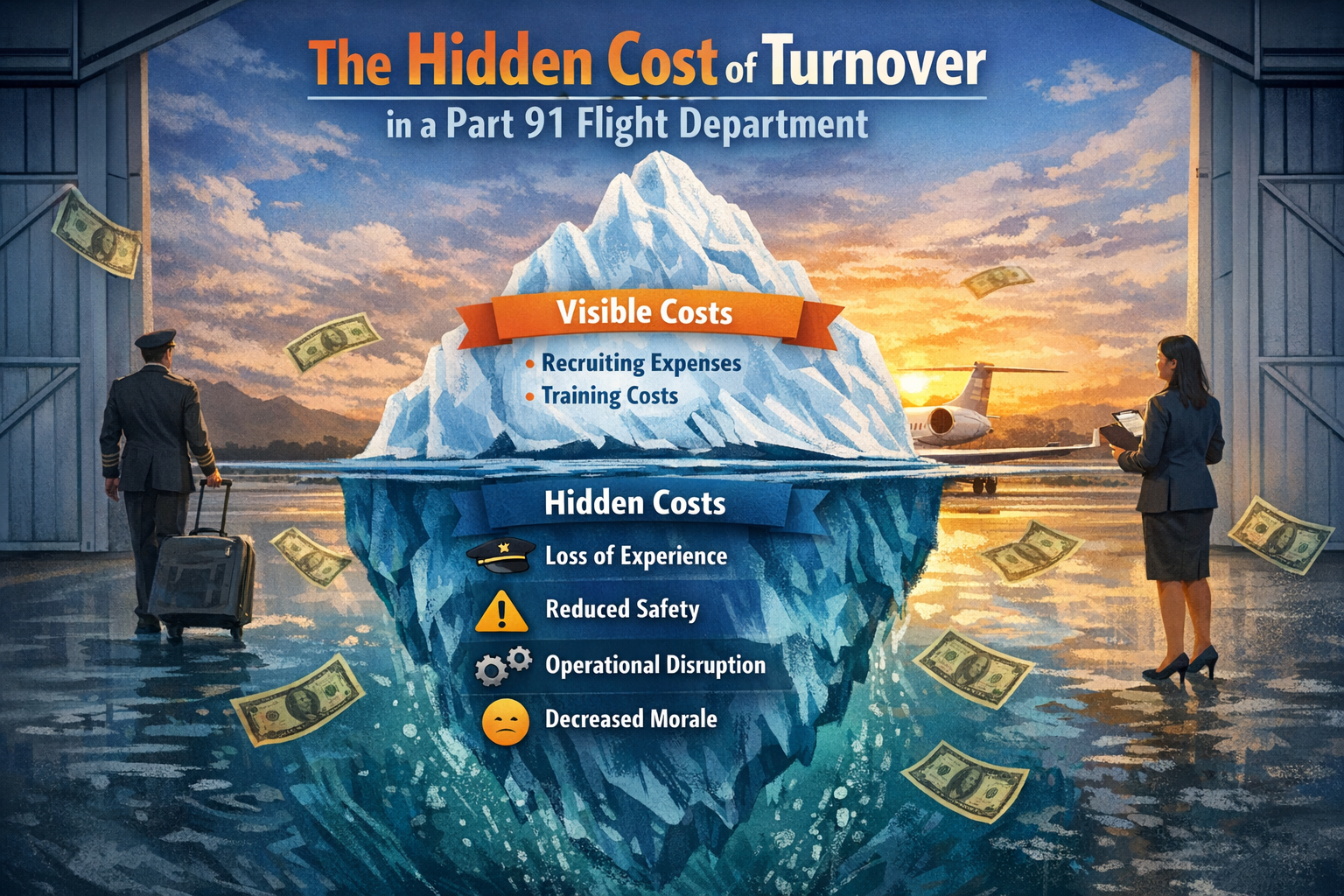
Turnover is expensive—far more expensive than most owners realize.
Direct Costs
These are the obvious expenses:
- Recruiting fees
- Interview travel
- Simulator training
- Type ratings
- Relocation packages
- Onboarding time
Replacing a single pilot can easily exceed $75,000–$150,000 depending on aircraft type and training requirements.
Indirect Costs
These are the costs that define the hidden cost of turnover:
- Lost productivity during onboarding
- Increased workload on remaining staff
- Schedule disruptions
- Owner frustration or loss of confidence
- Reduced aircraft utilization
- Documentation errors or delays
These indirect costs often exceed the direct ones.
The Cost of Losing the Wrong Person
In small departments, losing a chief pilot, DOM, or scheduler can destabilize the entire operation. The cost isn’t measured in dollars—it’s measured in:
- Safety risk
- Operational inconsistency
- Loss of institutional memory
- Decline in morale
This is where turnover becomes existential.
How Turnover Disrupts Safety Culture
Safety culture is built on consistency, communication, and shared expectations. Turnover disrupts all three.
Loss of Shared Mental Models
A stable team develops a shared understanding of:
- How decisions are made
- How risk is evaluated
- How the owner prefers to operate
- How to handle abnormal situations
When a new person enters the system, those mental models must be rebuilt from scratch.
Increased Cognitive Load on Remaining Staff
Remaining team members must:
- Train the new hire
- Cover additional flights
- Manage unfamiliar workflows
- Double‑check tasks that were previously automatic
This increases fatigue and reduces margin.
Temporary Erosion of Just Culture
New hires hesitate to speak up. Existing staff avoid conflict. Leaders assume competence before it’s proven.
This creates a dangerous window where errors can slip through.
Owner Expectations and the Reality of Turnover
Part 91 owners expect:
- Seamless travel
- Familiar faces
- High‑touch service
- Absolute discretion
- Zero operational friction
Turnover threatens all of these.
Trust Must Be Rebuilt
Owners often fly with the same pilots for years. They trust them with:
- Their safety
- Their family
- Their business secrets
- Their time
When a pilot leaves, that trust resets to zero.
Owners Feel the Disruption Immediately
Unlike airline passengers, Part 91 owners know their crew personally. A departure feels like a loss, not a staffing change.
Turnover Creates Perceived Instability
Even if the department is functioning well, turnover can make the owner question:
- Leadership
- Compensation structure
- Culture
- Workload
- Future reliability
Perception alone can trigger further changes—or further turnover.
The Operational Ripple Effect
Turnover doesn’t just affect the cockpit. It affects the entire operation.
Scheduling and Trip Planning Slow Down
New pilots require:
- More conservative duty days
- More time for preflight planning
- More oversight from leadership
This reduces flexibility and increases workload.
Maintenance Coordination Becomes More Complex
A new DOM or technician must learn:
- Aircraft history
- Owner preferences
- Vendor relationships
- Inspection cycles
Mistakes here can ground the aircraft or increase costs.
Administrative and Regulatory Compliance Suffers
Turnover can disrupt:
- Training records
- Manual revisions
- LOAs
- Insurance requirements
- Audit readiness
These disruptions often go unnoticed until a problem arises.
The Cultural Cost—The Most Dangerous Hidden Cost of Turnover
Culture is the glue that holds a Part 91 department together. Turnover weakens that glue.
Morale Declines
Remaining staff may feel:
- Overworked
- Undervalued
- Uncertain about leadership
- Concerned about future turnover
Low morale is contagious.
Standards Drift
When experienced personnel leave, standards often slip—not intentionally, but gradually.
- Checklists become less consistent
- Communication becomes less crisp
- SOPs become more flexible
- Informal shortcuts reappear
This drift is one of the most dangerous hidden costs of turnover.
Recruitment Becomes Harder
High turnover signals instability. Instability repels top talent. Lower‑quality candidates increase future turnover.
It becomes a cycle.
How Part 91 Departments Can Reduce Turnover
Turnover is not inevitable. It’s preventable with intentional leadership.
Build a Culture of Stability
- Clear SOPs
- Transparent communication
- Predictable schedules
- Respect for personal time
- Professional development pathways
Align Compensation With Market Reality
Airlines are hiring aggressively. Corporate pilots have options. Compensation must reflect that reality.
Protect Work‑Life Balance
Burnout is one of the top drivers of turnover. Predictability is a competitive advantage.
Invest in Leadership
Strong leadership reduces turnover more effectively than any pay raise.
Document Everything
Reduce the impact of turnover by ensuring:
- SOPs are written
- Owner preferences are documented
- Maintenance history is clear
- Training workflows are standardized
Documentation protects continuity.
The Real Hidden Cost of Turnover
The true hidden cost of turnover in Part 91 flight departments is not financial—it’s relational.
It’s the erosion of trust. The disruption of safety culture. The loss of continuity. The destabilization of a system built on familiarity and precision.
Turnover is not just a staffing issue. It is a strategic risk.
Departments that understand this—and act on it—protect not only their people but the owner’s mission, safety, and long‑term confidence in the operation.