Table of Contents
A Strategic Comparison of Two Fundamentally Different Hiring Systems
There is a tendency in aviation hiring to assume that all pilot recruitment follows the same basic model. But the reality of airline vs corporate pilot hiring quickly challenges that assumption. Post a job. Review applications. Conduct interviews. Extend an offer. But that assumption breaks down quickly when comparing airline and corporate aviation. Because the reality is this:
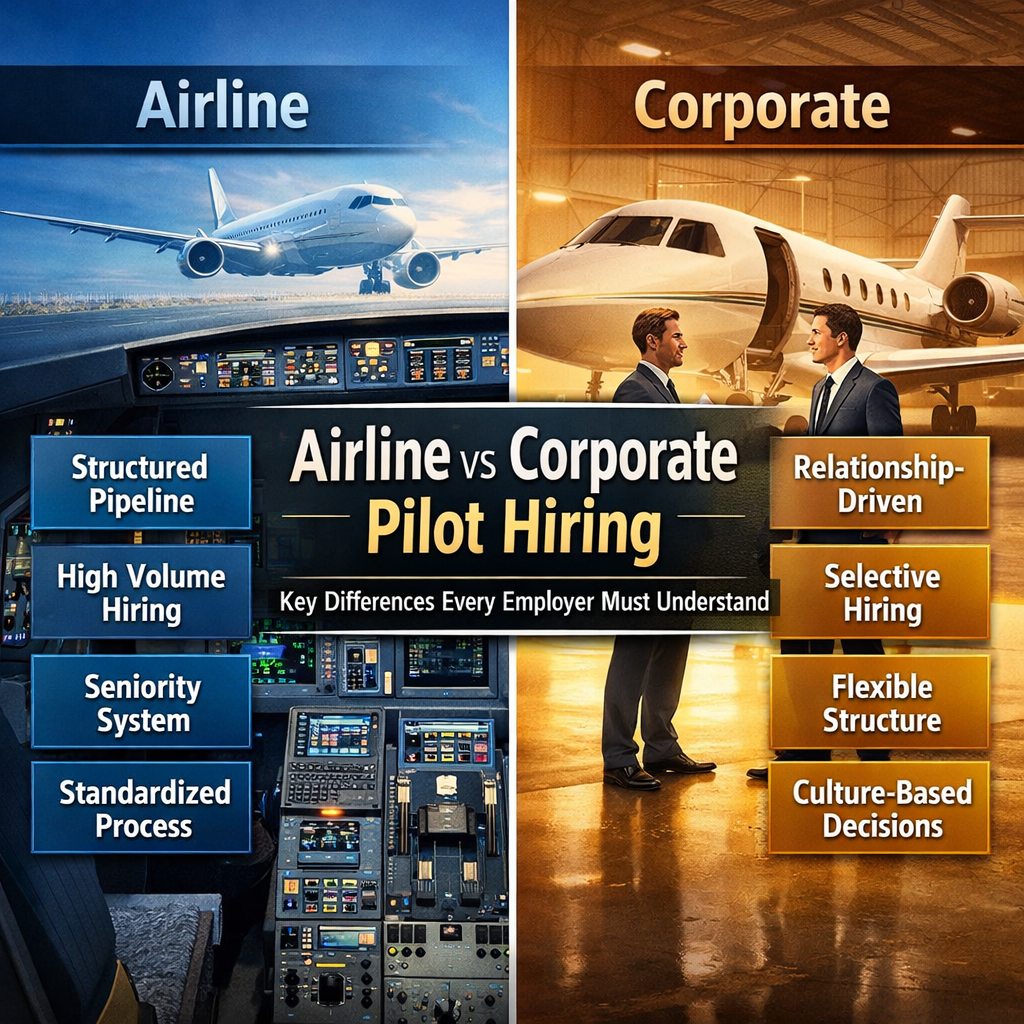
Airline vs corporate pilot hiring are not variations of the same system. They are entirely different systems built on different priorities, structures, and outcomes.
For employers, understanding these differences is not academic—it is operationally critical. Hiring strategies that work in one environment often fail in the other.
What Is Airline vs Corporate Pilot Hiring?
At its simplest, airline vs corporate pilot hiring can be understood as a comparison between:
- Structured, pipeline-driven hiring (airlines)
- Relationship-driven, decentralized hiring (corporate aviation)
Airlines operate at scale. Corporate operators operate with precision.
This distinction influences everything from candidate sourcing to interview processes to long-term retention.
Hiring Structure: Pipeline vs Precision
The most significant difference in airline vs corporate pilot hiring lies in how candidates enter the system.
Airline Hiring Model


Airlines rely on highly structured pipelines:
- University and cadet programs
- Regional airline flow-through agreements
- Defined minimum qualifications (ATP, hours, type ratings)
- High-volume recruiting systems
Candidates move through a predictable progression. Hiring is designed for throughput and scalability.
This is one of the most overlooked aspects of airline vs corporate pilot hiring.
Corporate Hiring Model
Corporate aviation hiring is far less centralized:
- No standardized pipeline
- Heavy reliance on referrals and networks
- Candidate sourcing often begins only when a need arises
- Hiring decisions are highly individualized
This makes corporate hiring more flexible—but also more vulnerable to inconsistency.
Understanding this structural difference is foundational to mastering airline vs corporate pilot hiring.
Candidate Behavior: Active vs Passive
Another defining factor in airline vs corporate pilot hiring is how candidates behave.
Airline Candidates
Airline candidates are typically:
- Actively pursuing airline careers
- Tracking hiring windows and requirements
- Willing to relocate
- Focused on long-term seniority progression
They are in the market.
Corporate Candidates
Corporate pilots are often:
- Currently employed
- Not actively job searching
- Selective about opportunities
- Influenced by reputation and relationships
They are not in the market—they must be engaged into it.
This distinction is why traditional job postings are less effective in corporate aviation.
Speed vs Selectivity
In the comparison of airline vs corporate pilot hiring, speed means very different things.
Airlines: Speed Through Volume
Airlines optimize for:
- Rapid hiring cycles
- Large candidate pools
- Standardized evaluation criteria
Speed is achieved through process efficiency.
Corporate Aviation: Speed Through Preparation
Corporate operators cannot rely on volume.
Instead, speed comes from:
- Pre-existing relationships
- Candidate pipelines
- Prior knowledge of available pilots
Without preparation, hiring becomes slow and reactive.
Evaluation Criteria: Standardization vs Judgment
Airlines and corporate operators evaluate pilots differently.
Airline Evaluation
Airlines use:
- Structured interviews
- Simulator evaluations
- Behavioral and technical scoring systems
Candidates are assessed against standardized benchmarks.
Corporate Evaluation

Corporate hiring is more nuanced:
- Cultural fit
- Customer interaction skills
- Crew compatibility
- Operational flexibility
Two pilots with identical flight time may be evaluated very differently depending on the operation.
This subjectivity is a defining feature of airline vs corporate pilot hiring.
Compensation and Value Proposition
Compensation structures differ significantly in airline vs corporate pilot hiring.
Airline Compensation
- Defined pay scales
- Union-negotiated contracts
- Seniority-based progression
- Long-term earnings visibility
The value proposition is predictability and progression.
Corporate Compensation
- Variable salary structures
- Greater flexibility in negotiation
- Benefits tied to company resources
- Quality-of-life considerations
The value proposition is flexibility and lifestyle.
Employers must understand that pilots are not simply comparing salaries—they are comparing entire career models.
Retention Dynamics
Retention strategies diverge sharply in airline vs corporate pilot hiring.
Airlines
Retention is built into the system:
- Seniority discourages movement
- Pension and long-term benefits create stickiness
- Career progression is linear
Corporate Aviation
Retention must be actively managed:
- Schedule quality
- Leadership effectiveness
- Operational consistency
- Culture and communication
Without deliberate effort, turnover risk remains high.
Retention strategies diverge sharply in airline vs corporate pilot hiring, particularly when comparing long-term stability models.
Compliance and Regulatory Influence
While both sectors operate under FAA regulations, the impact on hiring differs.
Airline Hiring
- Highly standardized training programs
- Centralized compliance systems
- Uniform qualification pathways
Corporate (Part 135) Hiring
- Operator-specific requirements
- Insurance-driven minimums
- Greater variability in qualification standards
This makes compliance a more dynamic factor in corporate hiring decisions.
Why Employers Get This Wrong
Many operators struggle with airline vs corporate pilot hiring because they attempt to apply airline-style thinking to corporate environments.
Common mistakes include:
- Relying solely on job postings
- Waiting for applicants instead of building pipelines
- Overemphasizing minimum qualifications
- Underestimating the importance of relationships
These approaches create friction in a market where access to talent is the primary constraint.
The Strategic Advantage of Corporate Aviation
Corporate aviation cannot out-scale the airlines.
But it does not need to.
Its advantage lies in:
- Flexibility
- Personalization
- Direct relationships
- Operational autonomy
Employers who understand airline vs corporate pilot hiring can position their operation as a compelling alternative—not a secondary option.
Final Insight
The comparison of airline vs corporate pilot hiring is not about which system is better.
It is about which system you are operating within—and whether your hiring strategy reflects that reality.
Airlines succeed through structure.
Corporate aviation succeeds through relationships.
The operators who recognize this distinction—and build their hiring systems accordingly—will not only compete in this market.
They will define their place within it.