
<p>The post Retaining Aircraft Maintenance Technicians: What Actually Works in 2026 first appeared on Aviation Careers.</p>
]]>Table of Contents
Retaining Aircraft Maintenance Technicians has become one of the most urgent challenges in aviation. Airlines, MROs, corporate flight departments, and Part 135 operators are all competing for the same shrinking pool of A&P mechanics, avionics technicians, and structures specialists. With retirements accelerating and training pipelines lagging behind demand, the organizations that win the retention battle will be the ones that understand what technicians actually value — and what drives them away.
This guide breaks down what truly works for retaining Aircraft Maintenance Technicians in 2026, based on industry data, workforce trends, and proven employer practices. Any operator serious about Retaining Aircraft Maintenance Technicians must treat retention as a core operational function, not an HR afterthought.
Why Retention Matters More Than Recruitment
Recruiting new technicians is expensive, slow, and increasingly competitive. Losing an experienced A&P or avionics tech can cost an operator:
- Months of lost productivity
- Tens of thousands in recruiting and onboarding
- Reduced aircraft availability
- Increased overtime for remaining staff
- Higher risk of burnout and turnover
For operators focused on Retaining Aircraft Maintenance Technicians, the math is simple: retention protects operational reliability far more effectively than constant hiring.
What Technicians Say They Actually Want
Most employers assume technicians leave for money. Compensation matters — but it is rarely the only reason. Surveys consistently show that technicians prioritize:
- Respect and fair treatment
- Predictable schedules
- Career progression
- Modern tools and safe working conditions
- Competent leadership
- A culture that values maintenance, not just flight ops
Organizations committed to Retaining Aircraft Maintenance Technicians must understand that these non-financial factors often outweigh pay.
Proven Strategies for Retaining Aircraft Maintenance Technicians
Build a Culture That Respects Maintenance

Technicians stay where they feel respected. They leave when they feel ignored, rushed, or treated as an afterthought. Culture is one of the strongest levers for Retaining Aircraft Maintenance Technicians.
What Respect Looks Like in Practice
- Leadership that listens to technicians’ concerns
- Realistic timelines for maintenance tasks
- No pressure to cut corners
- Recognition for quality work, not just speed
- Involving technicians in decisions that affect their workflow
A culture of respect is the single strongest predictor of long-term retention.
Offer Competitive, Transparent Compensation
Pay alone won’t fix retention — but inadequate pay will absolutely destroy it.
Compensation Strategies That Work
- Clear pay scales tied to experience and certifications
- Shift differentials for nights, weekends, and on-call
- Tool allowances or reimbursement
- Retention bonuses tied to tenure
- Performance-based incentives that reward quality and safety
Operators serious about Retaining Aircraft Maintenance Technicians must ensure compensation is competitive and clearly communicated.
Improve Scheduling and Work-Life Balance
Unpredictable schedules are one of the top reasons technicians leave aviation entirely.
Scheduling Improvements That Boost Retention
- Predictable shift rotations
- Reduced mandatory overtime
- Flexible scheduling for senior technicians
- Adequate staffing to prevent burnout
- On-call rotations that are fair and evenly distributed
Work-life balance is a major driver in Retaining Aircraft Maintenance Technicians, especially among younger A&Ps.
Invest in Career Development
Technicians want to grow — not stagnate.
Development Programs That Keep Technicians Engaged
- Paid training for advanced avionics, composites, or engine courses
- Support for Inspection Authorization (IA)
- Clear pathways to lead, supervisor, or controller roles
- Cross-training between airframe, powerplant, and avionics
- Tuition assistance for continuing education
Career development is one of the most effective long-term strategies for Retaining Aircraft Maintenance Technicians.
Modernize Tools, Equipment, and Facilities
Nothing frustrates technicians more than outdated tools or unsafe workspaces.
Facility and Equipment Upgrades That Matter
- Modern diagnostic equipment
- Updated tooling and calibrated equipment
- Clean, well-lit hangars
- Climate-controlled workspaces where possible
- Digital task cards and modern maintenance software
Investing in tools is investing in retention — and it directly supports Retaining Aircraft Maintenance Technicians.
Strengthen Leadership at the Supervisor Level
Technicians don’t quit companies — they quit supervisors.
Leadership Behaviors That Improve Retention
- Fair workload distribution
- Clear communication
- Support during AOG or high-pressure events
- Advocacy for technician needs
- Consistent enforcement of safety and quality standards
Leadership quality is one of the most overlooked factors in Retaining Aircraft Maintenance Technicians.
Build a Strong Onboarding and Mentorship Program
Are you in need of A&P Mechanics? Post an ad now!
The first 90 days determine whether a new technician stays long-term.
Onboarding Elements That Work
- A structured orientation to the company, aircraft, and procedures
- A dedicated mentor for the first 6–12 months
- Clear expectations for performance and advancement
- Early wins that build confidence
Strong onboarding dramatically increases the odds of Retaining Aircraft Maintenance Technicians during their first year.
Create a Safe, No-Blame Maintenance Environment
Safety culture is retention culture.
Safety Practices That Keep Technicians Loyal
- A just culture that separates human error from negligence
- Encouragement to report hazards without fear
- Thorough root-cause analysis, not finger-pointing
- Leadership that prioritizes safety over schedule pressure
Technicians stay where they feel safe and supported.
The Hidden Drivers of Technician Turnover
Beyond pay and scheduling, several subtle factors push technicians out the door:
- Lack of recognition
- Poor communication from leadership
- Inconsistent enforcement of standards
- Favoritism in promotions or assignments
- A perception that flight ops “runs the show”
Addressing these issues is essential for Retaining Aircraft Maintenance Technicians in a competitive labor market.
The Bottom Line
Retaining Aircraft Maintenance Technicians is not about gimmicks, slogans, or one-time bonuses. It is about building an environment where technicians feel respected, supported, and valued for the critical safety role they play.
Organizations that invest in culture, leadership, compensation, scheduling, and career development will not only retain their technicians — they will outperform competitors in aircraft availability, safety, and operational reliability.
Retention is not a program. It is a commitment.
<p>The post Retaining Aircraft Maintenance Technicians: What Actually Works in 2026 first appeared on Aviation Careers.</p>
]]><p>The post Aviation Maintenance Staffing Shortage: 3 Hidden Drivers and the Frustrating Industry Impact first appeared on Aviation Careers.</p>
]]>Table of Contents
Understanding the Aviation Maintenance Staffing Shortage
The aviation maintenance staffing shortage has become one of the most pressing operational challenges across the global aviation industry. Airlines, Part 135 operators, MRO providers, and corporate flight departments are all competing for a limited pool of qualified A&P mechanics. This shortage is not a temporary disruption—it is a structural issue that directly impacts safety, aircraft availability, and revenue generation.
At its core, the aviation maintenance staffing shortage is driven by a mismatch between supply and demand. Aircraft fleets are expanding, utilization rates are increasing, and regulatory requirements remain uncompromising. Meanwhile, the pipeline of new technicians entering the workforce is insufficient to replace those exiting it.
For employers, this is no longer just a hiring problem. It is a strategic risk that requires long-term workforce planning and deliberate intervention.
Root Causes of the Aviation Maintenance Staffing Shortage
Aging Workforce and Retirements
One of the most significant contributors to the aviation maintenance staffing shortage is the aging technician workforce. A large percentage of certificated mechanics are nearing retirement age, and many are exiting the industry faster than they can be replaced.
This demographic shift creates a knowledge gap as well. Experienced technicians carry institutional expertise that is not easily transferred, particularly in complex aircraft systems and troubleshooting environments.
Limited Training Pipeline
The pipeline of new A&P mechanics is constrained. FAA Part 147 schools are producing graduates, but not at a rate sufficient to meet industry demand. Additionally, enrollment in these programs has historically lagged behind other technical and trade professions.
Barriers to Entry
Several factors limit the growth of the training pipeline:
- High upfront training costs
- Limited awareness of aviation maintenance careers
- Competition from other skilled trades offering faster entry and comparable pay
- Geographic concentration of schools, limiting accessibility
These barriers directly contribute to the aviation maintenance staffing shortage by restricting the inflow of new talent.
Competition from Other Industries
Aviation is no longer competing only within its own ecosystem. Skilled technicians are being recruited by industries such as energy, manufacturing, and advanced electronics.
Compensation and Lifestyle Pressures
Many of these competing industries offer:
- Higher starting salaries
- More predictable schedules
- Less regulatory pressure
- Reduced liability exposure
As a result, aviation maintenance struggles to retain talent, further exacerbating the aviation maintenance staffing shortage.
Post-Pandemic Workforce Disruption
The COVID-19 downturn led to furloughs, layoffs, and early retirements across aviation. Many technicians who left the industry did not return. Some transitioned permanently into other sectors.
The rebound in travel demand has been rapid, but the workforce recovery has lagged significantly. This imbalance has intensified the aviation maintenance staffing shortage across all segments.
Increasing Technical Complexity
Modern aircraft are more advanced than ever, incorporating digital avionics, composite materials, and integrated systems. This evolution requires a higher level of technical proficiency and ongoing training.
Skills Gap Expansion
The result is not just a shortage of technicians—but a shortage of qualified technicians. Employers are often forced to choose between underqualified candidates or leaving positions unfilled.
This widening skills gap is a defining feature of the aviation maintenance staffing shortage.
Operational Impact of the Aviation Maintenance Staffing Shortage

The aviation maintenance staffing shortage is not an abstract concern. It has direct operational consequences:
Reduced Aircraft Availability
When maintenance staffing levels are insufficient, aircraft spend more time on the ground awaiting inspection, repair, or return-to-service authorization. This reduces fleet utilization and revenue potential.
Increased Labor Costs
Competition for qualified technicians drives up wages, signing bonuses, and retention incentives. While necessary, these costs compress margins—especially for smaller operators.
Compliance and Safety Risk
Maintenance delays and workforce fatigue increase the risk of human error. Regulatory compliance remains non-negotiable, but staffing shortages place additional pressure on existing teams.
Slower Growth and Expansion
Operators looking to scale fleets or expand operations may be constrained by their ability to staff maintenance positions. In this way, the aviation maintenance staffing shortage becomes a growth limiter.
Strategic Solutions to the Aviation Maintenance Staffing Shortage
As the aviation maintenance staffing shortage continues to impact operations, Aviation Employment Network offers employers a practical solution for sourcing and attracting qualified technicians.
Addressing the aviation maintenance staffing shortage requires a multi-layered approach. Tactical hiring alone will not solve the problem. Employers must think in terms of pipeline development, retention, and long-term workforce strategy.
Build Direct Talent Pipelines
Organizations must actively engage with Part 147 schools and technical programs.
Structured Partnerships
Effective strategies include:
- Sponsoring students through training programs
- Offering internships and apprenticeships
- Creating conditional job offers prior to graduation
- Embedding company presence within school ecosystems
This approach ensures a consistent inflow of entry-level talent and reduces reliance on the open market.
Enhance Compensation and Career Pathways
Compensation must be competitive, but equally important is the visibility of career progression.
Define Advancement Tracks
Technicians should clearly understand pathways such as:
- Lead mechanic roles
- Inspection authorization (IA) progression
- Quality assurance and safety roles
- Management and director-level opportunities
When career growth is visible and attainable, retention improves and the aviation maintenance staffing shortage becomes more manageable.
Improve Work Environment and Scheduling
Lifestyle matters. Employers who address quality-of-life factors gain a competitive advantage.
Operational Adjustments
Consider:
- Predictable shift schedules
- Reduced overtime dependency
- Investment in modern tooling and facilities
- Strong safety culture and leadership engagement
These improvements directly influence technician satisfaction and retention.
Expand Recruitment Channels
Traditional recruiting methods are no longer sufficient.
Broaden the Talent Pool
Employers should explore:
- Military transition programs
- Cross-training from adjacent technical fields
- Second-career candidates
- Geographic relocation incentives
Expanding the candidate base is essential to mitigating the aviation maintenance staffing shortage.
Check this article out on How to Hire A&P Mechanics.
Invest in Training and Upskilling
Given the increasing complexity of aircraft systems, ongoing training is not optional.
Internal Development Programs
Companies that invest in:
- Recurrent technical training
- Manufacturer-specific courses
- Mentorship programs
- Structured onboarding
will develop higher-quality technicians and reduce dependency on external hiring.
Long-Term Outlook for the Aviation Maintenance Staffing Shortage
The aviation maintenance staffing shortage is unlikely to resolve quickly. Demand for air travel continues to grow, and fleet expansion will persist across both commercial and private sectors.
Organizations that treat this challenge as a strategic priority—rather than a reactive hiring issue—will position themselves for long-term success. Those that fail to adapt will face increasing operational constraints, rising costs, and competitive disadvantage.
The solution is not singular. It is systemic. Build the pipeline. Retain the talent. Elevate the profession. That is how the aviation maintenance staffing shortage is solved.
<p>The post Aviation Maintenance Staffing Shortage: 3 Hidden Drivers and the Frustrating Industry Impact first appeared on Aviation Careers.</p>
]]><p>The post How Aviation Staffing Agencies Work: 5 Ways to Elevate Your Hiring Strategy first appeared on Aviation Careers.</p>
]]>Table of Contents
This guide explains How Aviation Staffing Agencies Work and when to use one. For airlines, airports, maintenance organizations, and other aviation operators, staffing is a highly regulated, safety-critical function. Understanding the mechanics of aviation staffing agencies can help you move faster, control costs, and maintain compliance without sacrificing quality. Below, you’ll find a practical overview of the process, the benefits, potential risks, and actionable tips to choose the right partner. By the end, you’ll see why many aviation teams rely on staffing specialists to fill both everyday roles and hard-to-find expertise. How Aviation Staffing Agencies Work is often the difference between a delayed project and a smooth, compliant hiring cycle.
What are aviation staffing agencies?
Aviation staffing agencies are specialized recruiting firms that focus on aviation-related roles, from pilots and avionics technicians to cabin crew, air traffic controllers, and ground-support staff. These agencies understand industry licensing, medical requirements, security clearances, and union or contractor considerations that are unique to aviation. They act as intermediaries who source talent, screen for essential credentials, and manage the logistics of placement. In essence, they embody the question of How Aviation Staffing Agencies Work by combining talent pipelines with rigorous compliance and process discipline.
Key components of How Aviation Staffing Agencies Work

To grasp the value of aviation staffing agencies, it helps to break down the core components of their model. The following sections describe the typical lifecycle from client engagement to candidate placement, and how each step aligns with the central idea of How Aviation Staffing Agencies Work.
Sourcing and vetting talent
One of the most important stages in How Aviation Staffing Agencies Work is building a pool of qualified candidates. Agencies tap multiple channels—industry networks, flight schools, maintenance schools, and licensed professionals who maintain current certifications. They conduct credential verification, license validation, medical examinations, and security checks as applicable to the role and jurisdiction. They may also administer job-relevant assessments to evaluate technical skills and safety acumen. This rigorous vetting helps ensure that when you hire through an agency, you’re relying on a pipeline that aligns with aviation standards and your operational requirements.
Candidate sourcing
Aggressive sourcing strategies help agencies locate active and passive candidates who meet the precise criteria for aviation roles.
AVIATION EMPLOYMENT NETWORK CAN HELP WITH YOUR SOURCING NEEDS! CLICK HERE TO CHECK IT OUT.
Credential verification
Licenses, ratings, medical certificates, and regulatory approvals are checked before candidates proceed to client interviews or onboarding.
Assessment methods
Role-specific simulations, competency interviews, and safety-related assessments support quality decisions and reduce risk.
Placement and onboarding
Once a suitable candidate is identified, the agency coordinates placement, often providing contract terms, start dates, and onboarding support. This stage exemplifies How Aviation Staffing Agencies Work by translating candidate readiness into a seamless transition for the employer. Depending on the arrangement, placements can be temporary, temp-to-hire, or permanent. The onboarding process typically includes orientation, regulatory briefings, and any role-specific training required before the employee operates in a live environment.
Contract structures
Contracts may be short-term, long-term, or project-based. Agencies can offer payrolling, payroll administration, and benefits management for flexible labor models.
Induction and training
New hires may receive initial aviation-specific training or safety briefings so they meet client expectations from day one.
Compliance and safety considerations
Compliance is central to How Aviation Staffing Agencies Work. Aviation is a regulated field, so agencies must stay current with licensing, drug testing policies, background checks, and security requirements. They also monitor regulatory changes and adjust screening criteria accordingly. This focus on compliance protects both the employer and the worker while supporting safe, reliable operations.
Licensing and regulatory alignment
Agencies verify that qualifications match regional and airline-specific requirements.
Medical and fitness standards
Occupational health checks and flight/maintenance medicals ensure candidates are fit for duty when required.
Security and background checks
Background investigations align with industry and airport security standards, reducing risk for critical roles.
When to use a staffing agency in aviation
Knowing How Aviation Staffing Agencies Work helps you decide the right time to engage a partner. Consider these scenarios where an agency can add value:
- Surges in demand, such as peak travel seasons, fleet expansions, or large maintenance campaigns.
- Specialized roles with tight licensing or certification requirements, like certain avionics or aeronautical engineering positions.
- Geographic or international hiring where local regulations and visa issues complicate direct hires.
- The need for rapid filling to minimize flight cancellations, grounded aircraft, or delayed projects.
- Temporary coverage during sickness, leaves, or training periods that requires temporary-to-permanent solutions.
In these contexts, the ability to ramp talent quickly while maintaining regulatory compliance is a practical demonstration of How Aviation Staffing Agencies Work, and it often leads to faster operations and lower cost of hire over time.
Benefits of outsourcing hiring to an aviation staffing agency
Partnering with a staffing agency in aviation delivers several concrete advantages. First, you gain access to a curated pipeline of pre-screened, qualified candidates who already understand industry standards. This accelerates How Aviation Staffing Agencies Work in practice, translating into shorter time-to-fill cycles. Second, agencies handle many compliance tasks, from licensing verification to safety training, reducing regulatory risk. Third, you can scale your workforce up or down with agility, supporting project-based needs without long-term commitments. Finally, agencies often offer payroll, benefits administration, and contingent workforce management, which can simplify HR operations during busy periods.
Risks and how to mitigate them

As with any hiring model, there are potential downsides to consider when evaluating How Aviation Staffing Agencies Work. Common concerns include cost sensitivity, misalignment between candidate and employer culture, and the risk of over-reliance on a single supplier. To mitigate these risks, define success metrics upfront (time-to-fill, quality of hire, retention). Request detailed screening criteria, establish clear service-level agreements, and ask for access to the agency’s candidate pool data and compliance documentation. A well-scoped engagement aligned with your safety and operational goals makes How Aviation Staffing Agencies Work a reliable asset rather than a cost center.
How to choose the right aviation staffing agency
Choosing the right partner is critical to maximizing the value of How Aviation Staffing Agencies Work. Look for agencies with:
- Specialization in aviation and a track record with your role types (pilots, technicians, cabin crew, etc.).
- Proven compliance processes, credentialing accuracy, and strong safety culture.
- Transparent pricing, contract flexibility, and clear SLAs.
- Robust candidate pipelines, fast onboarding capabilities, and good references from similar operators.
- Data security practices and a clear policy for IP and worker classification (contractor vs. employee).
When evaluating potential partners, ask for case studies, pilot staffing metrics, and a demo of their screening and onboarding workflow. If you’re unsure about How Aviation Staffing Agencies Work in your specific context, request a short pilot or trial period to assess fit without a long-term commitment.
Conclusion
Ultimately, How Aviation Staffing Agencies Work boils down to balancing speed, quality, compliance, and cost. A good aviation staffing partner brings a rigorous vetting process, regulatory expertise, and scalable solutions that align with safety and operational goals. If you’re navigating surge demand, niche roles, or international hiring, engaging an aviation staffing agency can transform hiring from a bottleneck into a strategic strength. By understanding the mechanics and carefully selecting a partner, airlines and aviation entities can realize faster fills, reduced risk, and a more resilient workforce.
Related Posts


<p>The post How Aviation Staffing Agencies Work: 5 Ways to Elevate Your Hiring Strategy first appeared on Aviation Careers.</p>
]]><p>The post Aviation Workforce Planning: A High‑Impact Forecasting Guide to Strengthen Your 2027 Workforce first appeared on Aviation Careers.</p>
]]>Table of Contents
Aviation employers are entering a period where Aviation Workforce Planning is no longer a background HR function. It has become a strategic capability that determines whether an organization can operate reliably, grow sustainably, and compete for scarce talent. The labor environment leading into 2027 will be shaped by accelerating retirements, limited training capacity, new aircraft deliveries, and rising wage competition. Employers that build a disciplined, data‑driven approach to long‑range workforce forecasting will be positioned to hire, train, and retain talent while others struggle with shortages.
This article outlines a complete, forward‑looking framework for Aviation Workforce Planning, designed for operators, MROs, OEMs, FBOs, charter companies, and training organizations preparing for 2027.
The Strategic Imperative Behind Aviation Workforce Planning for 2027
The next several years will bring structural changes that make Aviation Workforce Planning essential. Mandatory retirements will accelerate as the 1960s‑born cohort ages out. Regional airlines will continue losing pilots to major carriers, creating downstream shortages. AMT and avionics technician pipelines remain thin, with training capacity lagging industry demand. New aircraft deliveries—especially narrow‑body fleets and business aviation platforms—will require additional crews and maintenance staff. Wage competition will intensify as employers fight for the same limited talent pool.
Organizations that treat Aviation Workforce Planning as a long‑range forecasting discipline, rather than a reactive hiring function, will be able to stabilize operations and reduce churn.
Building a Long‑Range Aviation Workforce Planning Model
A robust Aviation Workforce Planning model for 2027 requires a structured approach that integrates operational data, training timelines, and market intelligence. The following components form the backbone of a reliable forecasting system.
Establish a 36‑Month Forecasting Horizon
Most aviation roles require long lead times. Pilots often need 12–24 months from hiring to line readiness. AMTs may require 6–18 months depending on experience and type ratings. Dispatchers typically need 3–6 months, while ramp, line service, and customer service roles require 1–3 months. Because of these timelines, Aviation Workforce Planning must extend at least three years ahead. A 36‑month horizon allows employers to anticipate retirements, attrition, fleet changes, and training bottlenecks.
Map Current Workforce Inventory
A detailed workforce inventory is the foundation of accurate workforce forecasting. Employers should categorize employees by age, retirement eligibility, certificates, ratings, type qualifications, seniority, upgrade readiness, training currency, and geographic location. This inventory becomes the baseline for all future Aviation Workforce Planning calculations.
Identify Predictable Workforce Losses
Forecasting 2027 hiring needs requires quantifying predictable losses. These include retirements, attrition, internal movement, and training washouts. Aviation employers often underestimate attrition. A realistic Aviation Workforce Planning model uses historical data, not optimistic assumptions.
Align Workforce Needs With Operational Growth
Hiring needs for 2027 must be tied to operational plans. Fleet expansion, new routes, new bases, increased utilization rates, seasonal demand patterns, and contractual service level agreements all influence staffing requirements. Every operational change has a staffing multiplier. One additional aircraft may require 10–14 pilots, 4–6 AMTs, and multiple support roles. A new base may require 20–50 hires across all functions. Integrating these multipliers into Aviation Workforce Planning ensures hiring aligns with real operational demand.
Forecasting Pilot Hiring Needs for 2027

Pilot supply will remain the most constrained segment of the aviation workforce. Employers must build forecasting models that account for both internal and external pressures.
Key Variables in Pilot Workforce Forecasting
Retirement curves, upgrade timelines, flow‑through agreements, compensation competitiveness, and training pipeline throughput all influence pilot availability. Employers that fail to integrate these variables into Aviation Workforce Planning will face chronic understaffing by 2027.
Pilot Training Capacity as a Limiting Factor
Training bottlenecks are now a primary constraint. Simulator availability, instructor staffing, check airman capacity, recurrent training cycles, and type‑rating backlogs all limit throughput. A realistic Aviation Workforce Planning model must include training capacity limits. Hiring 200 pilots is meaningless if only 120 can be trained annually.
Forecasting AMT and Avionics Technician Needs for 2027
AVIATION EMPLOYMENT NETWORK: Post Your Job Openings Today!
Technician shortages will intensify as older mechanics retire and fewer new entrants complete A&P programs. Employers must forecast needs with precision.
Key Variables in Technician Workforce Forecasting
Age distribution, retirement eligibility, type‑rating requirements, scheduled vs. unscheduled maintenance ratios, OEM service bulletin cycles, and fleet modernization timelines all influence technician demand. Because AMTs and avionics technicians require specialized skills, Aviation Workforce Planning must anticipate training needs years in advance.
Strengthening the Technician Pipeline
Employers should integrate pipeline‑building into their 2027 plan. Partnerships with A&P schools, tuition reimbursement, apprenticeships, internal upskilling programs, and cross‑training between airframes all strengthen the pipeline. These initiatives must be embedded into long‑range Aviation Workforce Planning, not treated as ad‑hoc HR projects.
Using Data Analytics to Improve Aviation Workforce Planning
Modern Aviation Workforce Planning relies on data, not intuition. Employers should build dashboards that track attrition rates, training throughput, vacancy rates, time‑to‑hire metrics, cost‑per‑hire, training cost, productivity, and utilization metrics. Data transforms workforce forecasting from guesswork into a measurable, repeatable process.
Predictive Modeling for 2027 Hiring Needs
Predictive analytics can forecast retirement spikes, high‑attrition roles, wage competition impacts, base‑level staffing needs, and training bottleneck effects. Employers that adopt predictive modeling will outperform those relying on manual spreadsheets.
Integrating Compensation Strategy Into Workforce Forecasting
Compensation is now a strategic variable in Aviation Workforce Planning. Wage competition will intensify through 2027, especially for captains, turbine‑experienced first officers, A&P technicians, avionics specialists, and dispatchers. Employers must forecast not only headcount but also compensation escalation. A realistic 2027 plan includes market‑based pay adjustments, retention bonuses, training completion incentives, and geographic differentials. Ignoring compensation trends will undermine even the best Aviation Workforce Planning model.
Building a 2027 Workforce Planning Playbook
A complete Aviation Workforce Planning playbook includes a workforce inventory, a 36‑month forecasting model, a training capacity plan, a compensation strategy, pipeline development initiatives, and risk mitigation strategies. This playbook becomes the employer’s roadmap for 2027.
Conclusion — Workforce Forecasting Is Now a Competitive Advantage
The employers that win in 2027 will be those that treat Aviation Workforce Planning as a strategic discipline. Accurate workforce forecasting allows organizations to prevent staffing shortages, reduce training bottlenecks, improve retention, control labor costs, and support operational growth. Aviation is entering a decade where talent—not aircraft—will be the limiting factor. Employers that master Aviation Workforce Planning today will be the ones operating at full strength in 2027.
You might be interested in this article as well…
How Aviation Staffing Agencies Work: 5 Ways to Elevate Your Hiring Strategy
Related Posts

<p>The post Aviation Workforce Planning: A High‑Impact Forecasting Guide to Strengthen Your 2027 Workforce first appeared on Aviation Careers.</p>
]]><p>The post Build a Scalable Pilot Pipeline: How Part 135 Operators Create Predictable, Long‑Term Staffing Stability first appeared on Aviation Careers.</p>
]]>Table of Contents
Building a scalable pilot pipeline is no longer optional for Part 135 operators. The combination of fleet growth, retirements, and competitive hiring from Part 121 carriers has made it essential to build a scalable pilot pipeline that produces consistent, qualified SICs and future PICs. Operators who invest in structured progression, training agreements, and strategic partnerships are the ones who stabilize staffing, reduce training costs, and protect operational reliability.
This guide outlines how to build a scalable pilot pipeline using proven methods that align with safety, standardization, and long‑term workforce planning.
Why Part 135 Operators Must Build a Scalable Pilot Pipeline
The traditional “post a job and hope” model no longer works. Operators need predictable staffing to support charter demand, maintain customer confidence, and avoid costly cancellations. When you build a scalable pilot pipeline, you create a repeatable system that transforms new SICs into confident, standardized PICs on a timeline the company can sustain.
A scalable pipeline reduces:
- Training churn
- Upgrade delays
- Recruiting costs
- Operational disruptions
- Overreliance on last‑minute hiring
Instead, it creates a controlled flow of talent that matches your fleet plan and business goals.
SIC‑to‑PIC Progression: The Core of a Scalable Pilot Pipeline
A structured SIC‑to‑PIC progression is the backbone of any operator trying to build a scalable pilot pipeline. Without a clear path, SICs leave early, upgrades stall, and staffing becomes unpredictable.
Define a Transparent SIC Development Program
A formal SIC development program should outline:
- Required flight hours and experience
- Aircraft‑specific knowledge milestones
- CRM and ADM expectations
- SOP mastery and standardization benchmarks
- Professionalism and customer‑facing behavior
Why Transparency Matters
When SICs know exactly what is required for upgrade, they stay longer, train harder, and align with company culture. Transparency builds trust, and trust builds retention.
Create a PIC Upgrade Matrix
A PIC upgrade matrix removes subjectivity and ensures fairness. It should evaluate:
- Technical proficiency
- Systems knowledge
- Decision‑making under pressure
- Crew coordination
- Safety reporting participation
- Reliability and judgment
- Customer interaction skills
Data‑Driven Upgrades Improve Safety
Using a matrix ensures upgrades happen based on readiness—not staffing shortages. This protects safety, standardization, and your brand reputation.
Use Scenario‑Based Training for Real‑World Readiness
Scenario‑based training prepares SICs for the realities of Part 135 flying. Include:
- Weather‑driven go/no‑go decisions
- High‑workload IFR
- Diversion planning
- Passenger management
- Automation traps
- Fatigue and risk assessment
This approach ensures your future PICs are not just qualified—they are operationally mature.
Training Agreements: Protecting Your Investment Without Scaring Candidates
Training is expensive. A scalable pipeline requires predictable cost recovery, but training agreements must be fair, transparent, and legally sound.
Build Fair and Transparent Training Agreements
A strong agreement should include:
- 12–24 month commitment
- Monthly prorated repayment
- Clear cost breakdown
- Conditions for waiver (medical, furlough, company breach)
- Conditions for extension (disciplinary issues, training failures)
Avoid Predatory Language
Operators should avoid harsh penalties or vague repayment terms. Fair agreements attract better candidates and reduce legal risk.
Align Agreements With Career Progression
When training agreements are tied to meaningful progression—such as SIC development and PIC upgrade timelines—they feel like a partnership, not a trap. This alignment strengthens retention and helps you build a scalable pilot pipeline that pilots want to be part of.
Partnerships: The Multiplier That Expands Your Pilot Pipeline
Partnerships widen your funnel and reduce your cost per hire. The most successful operators build relationships that feed their pipeline year‑round.
University and Flight School Partnerships
Partner with:
- Part 141 flight schools
- University aviation programs
- Rotor‑to‑fixed‑wing academies
- Military transition programs
What to Offer Students
- Conditional job offers
- Mentorship programs
- Jumpseat observation (where allowed)
- “Day in the life” immersion weeks
- Career pathway presentations
These partnerships position your company as a career destination—not a stepping stone.
Simulator and Training Center Partnerships
Sim partnerships help you:
- Lock in annual training slots
- Reduce cost volatility
- Co‑develop LOFT scenarios
- Build SIC‑to‑PIC bridge courses
- Standardize training across your fleet
This consistency strengthens your ability to build a scalable pilot pipeline that produces predictable results.
OEM, MRO, and Industry Partnerships
OEMs and MROs often provide:
- Type‑specific training modules
- Joint maintenance/pilot training
- Safety data sharing
- Preferred pricing for recurrent events
Industry groups such as NBAA and regional aviation associations also provide access to talent pipelines and workforce development grants.
Internal Training Ecosystem: The Operator’s True Competitive Advantage

A scalable pipeline requires a unified training ecosystem that integrates every stage of pilot development.
Build a Modular Training Architecture
Your training system should include:
- New‑hire indoctrination
- SIC development program
- Recurrent training
- Upgrade training
- Check Pilot standardization
- CRM and safety refreshers
- Customer service training
Standardization Is the Secret Weapon
When Check Pilots and LCAs are aligned, scripted, and consistent, your entire operation becomes safer and more predictable. Standardization is the foundation of a scalable pipeline.
Conclusion: How to Build a Scalable Pilot Pipeline That Lasts
To build a scalable pilot pipeline, Part 135 operators must combine structured SIC‑to‑PIC progression, fair training agreements, and strategic partnerships. When these elements work together, operators gain predictable staffing, reduced training costs, and a stronger safety culture.
A scalable pipeline is not a recruiting strategy—it is an operational strategy. It protects your fleet plan, your customers, and your long‑term growth.
<p>The post Build a Scalable Pilot Pipeline: How Part 135 Operators Create Predictable, Long‑Term Staffing Stability first appeared on Aviation Careers.</p>
]]><p>The post The Hidden Cost of Turnover: The Quiet Threat Inside Corporate Aviation in 2026 first appeared on Aviation Careers.</p>
]]>Table of Contents
The hidden cost of turnover in Part 91 flight departments is one of the most underestimated risks in corporate aviation. It doesn’t appear on a balance sheet, it isn’t discussed in owner briefings, and it rarely becomes a formal agenda item. Yet it quietly erodes operational continuity, safety culture, and the trust‑based relationship between owner and crew that makes private aviation work.
Part 91 operations rely on stability. They rely on familiarity. They rely on a small team that knows the aircraft, the mission, and—most importantly—the owner. When turnover enters the picture, the disruption is immediate and far‑reaching. This article breaks down the true hidden cost of turnover and why retention must be treated as a strategic priority, not an HR afterthought.
Why Turnover Hits Part 91 Harder Than Any Other Aviation Sector
Airlines can absorb turnover. They have seniority lists, standardized training pipelines, and thousands of pilots who can step into a vacancy.
Part 91 departments do not.
The Owner‑Pilot Relationship Is Irreplaceable
Corporate aviation is personal. Pilots learn:
- The owner’s risk tolerance
- Preferred airports and FBOs
- Cabin service expectations
- Communication style
- Family dynamics
- Business rhythms and travel patterns
This knowledge cannot be transferred in a handoff meeting. It is earned through years of flying together. When a pilot leaves, the owner feels the loss immediately.
Operational Continuity Depends on Tribal Knowledge
FIND PILOTS AT AVIATION EMPLOYMENT NETWORK
Part 91 departments often operate with:
- Custom SOPs
- Unique aircraft configurations
- Tailored maintenance programs
- Nonstandard dispatch workflows
When a key person leaves, undocumented knowledge leaves with them. That creates operational drag, uncertainty, and increased workload for the remaining team.
Safety Culture Becomes Temporarily Fragile
Even when the new hire is highly qualified, turnover disrupts:
- Communication patterns
- Shared mental models
- Risk tolerance alignment
- Crew resource management
This fragility is one of the most dangerous hidden costs of turnover.
The Financial Impact Owners Rarely See
Turnover is expensive—far more expensive than most owners realize.
Direct Costs
These are the obvious expenses:
- Recruiting fees
- Interview travel
- Simulator training
- Type ratings
- Relocation packages
- Onboarding time
Replacing a single pilot can easily exceed $75,000–$150,000 depending on aircraft type and training requirements.
Indirect Costs
These are the costs that define the hidden cost of turnover:
- Lost productivity during onboarding
- Increased workload on remaining staff
- Schedule disruptions
- Owner frustration or loss of confidence
- Reduced aircraft utilization
- Documentation errors or delays
These indirect costs often exceed the direct ones.
The Cost of Losing the Wrong Person
In small departments, losing a chief pilot, DOM, or scheduler can destabilize the entire operation. The cost isn’t measured in dollars—it’s measured in:
- Safety risk
- Operational inconsistency
- Loss of institutional memory
- Decline in morale
This is where turnover becomes existential.
How Turnover Disrupts Safety Culture
Safety culture is built on consistency, communication, and shared expectations. Turnover disrupts all three.
Loss of Shared Mental Models
A stable team develops a shared understanding of:
- How decisions are made
- How risk is evaluated
- How the owner prefers to operate
- How to handle abnormal situations
When a new person enters the system, those mental models must be rebuilt from scratch.
Increased Cognitive Load on Remaining Staff
Remaining team members must:
- Train the new hire
- Cover additional flights
- Manage unfamiliar workflows
- Double‑check tasks that were previously automatic
This increases fatigue and reduces margin.
Temporary Erosion of Just Culture
New hires hesitate to speak up. Existing staff avoid conflict. Leaders assume competence before it’s proven.
This creates a dangerous window where errors can slip through.
Owner Expectations and the Reality of Turnover
Part 91 owners expect:
- Seamless travel
- Familiar faces
- High‑touch service
- Absolute discretion
- Zero operational friction
Turnover threatens all of these.
Trust Must Be Rebuilt
Owners often fly with the same pilots for years. They trust them with:
- Their safety
- Their family
- Their business secrets
- Their time
When a pilot leaves, that trust resets to zero.
Owners Feel the Disruption Immediately
Unlike airline passengers, Part 91 owners know their crew personally. A departure feels like a loss, not a staffing change.
Turnover Creates Perceived Instability
Even if the department is functioning well, turnover can make the owner question:
- Leadership
- Compensation structure
- Culture
- Workload
- Future reliability
Perception alone can trigger further changes—or further turnover.
The Operational Ripple Effect
Turnover doesn’t just affect the cockpit. It affects the entire operation.
Scheduling and Trip Planning Slow Down
New pilots require:
- More conservative duty days
- More time for preflight planning
- More oversight from leadership
This reduces flexibility and increases workload.
Maintenance Coordination Becomes More Complex
A new DOM or technician must learn:
- Aircraft history
- Owner preferences
- Vendor relationships
- Inspection cycles
Mistakes here can ground the aircraft or increase costs.
Administrative and Regulatory Compliance Suffers
Turnover can disrupt:
- Training records
- Manual revisions
- LOAs
- Insurance requirements
- Audit readiness
These disruptions often go unnoticed until a problem arises.
The Cultural Cost—The Most Dangerous Hidden Cost of Turnover
Culture is the glue that holds a Part 91 department together. Turnover weakens that glue.
Morale Declines
Remaining staff may feel:
- Overworked
- Undervalued
- Uncertain about leadership
- Concerned about future turnover
Low morale is contagious.
Standards Drift
When experienced personnel leave, standards often slip—not intentionally, but gradually.
- Checklists become less consistent
- Communication becomes less crisp
- SOPs become more flexible
- Informal shortcuts reappear
This drift is one of the most dangerous hidden costs of turnover.
Recruitment Becomes Harder
High turnover signals instability. Instability repels top talent. Lower‑quality candidates increase future turnover.
It becomes a cycle.
How Part 91 Departments Can Reduce Turnover
Turnover is not inevitable. It’s preventable with intentional leadership.
Build a Culture of Stability
- Clear SOPs
- Transparent communication
- Predictable schedules
- Respect for personal time
- Professional development pathways
Align Compensation With Market Reality
Airlines are hiring aggressively. Corporate pilots have options. Compensation must reflect that reality.
Protect Work‑Life Balance
Burnout is one of the top drivers of turnover. Predictability is a competitive advantage.
Invest in Leadership
Strong leadership reduces turnover more effectively than any pay raise.
Document Everything
Reduce the impact of turnover by ensuring:
- SOPs are written
- Owner preferences are documented
- Maintenance history is clear
- Training workflows are standardized
Documentation protects continuity.
The Real Hidden Cost of Turnover
The true hidden cost of turnover in Part 91 flight departments is not financial—it’s relational.
It’s the erosion of trust. The disruption of safety culture. The loss of continuity. The destabilization of a system built on familiarity and precision.
Turnover is not just a staffing issue. It is a strategic risk.
Departments that understand this—and act on it—protect not only their people but the owner’s mission, safety, and long‑term confidence in the operation.
Related Posts


<p>The post The Hidden Cost of Turnover: The Quiet Threat Inside Corporate Aviation in 2026 first appeared on Aviation Careers.</p>
]]><p>The post How Scheduling Volatility Impacts Pilot Retention first appeared on Aviation Careers.</p>
]]>Table of Contents
Understanding how scheduling volatility impacts pilot retention has become essential for airlines navigating a rapidly changing aviation landscape. While compensation, fleet type, and career progression remain important, scheduling stability has emerged as one of the most influential factors affecting whether pilots stay with an airline or look elsewhere. As pilot demand continues to outpace supply, airlines that fail to address scheduling volatility risk losing experienced aviators and weakening their operational reliability.
The Changing Expectations of Today’s Pilot Workforce
The pilot workforce has evolved significantly over the past decade. Newer generations entering the profession place a high value on work‑life balance, predictability, and personal time. Meanwhile, mid‑career and senior pilots who have endured industry cycles, mergers, and furloughs are less tolerant of chaotic schedules. This shift has made it increasingly important for airlines to understand how scheduling volatility impacts pilot retention and how it shapes pilot satisfaction.
Pilots today expect predictable monthly schedules, fair distribution of flying hours, consistent days off, and minimal last‑minute disruptions. When these expectations are not met, dissatisfaction grows quickly.
What Scheduling Volatility Looks Like in Airline Operations
Scheduling volatility can take many forms, all of which contribute to pilot frustration. These include last‑minute reassignments, unplanned reserve usage, irregular trip pairings, unexpected extensions, inconsistent days off, and large fluctuations in monthly flight hours. Each of these disruptions makes it harder for pilots to plan their personal lives, manage fatigue, and maintain a sense of stability.
When pilots experience frequent schedule changes, they often feel they have little control over their time. This lack of control is one of the primary reasons scheduling volatility impacts pilot retention so strongly.
The Psychological and Physical Toll of Unpredictable Schedules
Aviation is already a demanding profession, and unpredictable schedules add another layer of stress. Research across multiple industries shows that schedule instability contributes to chronic fatigue, increased anxiety, reduced sense of control, and higher burnout rates. For pilots, these effects are amplified due to the safety‑critical nature of their work and the strict medical requirements they must maintain.
Pilots rely on consistent rest patterns to manage fatigue and remain alert. When schedules change unexpectedly, sleep cycles are disrupted, commuting becomes more difficult, and personal commitments become harder to manage. Over time, these stressors accumulate, making pilots more likely to consider leaving for an airline with more stable scheduling practices.
How Scheduling Volatility Impacts Pilot Retention: Work‑Life Balance as a Key Driver of Retention
One of the most common reasons pilots cite for leaving an airline is the inability to maintain a healthy work‑life balance. Scheduling volatility disrupts family events, childcare arrangements, commuting plans, and personal commitments. Pilots with families or long commutes are especially sensitive to these disruptions.
When pilots feel they must choose between their career and their personal life, retention suffers. This is one of the clearest examples of how scheduling volatility impacts pilot retention, particularly among mid‑career pilots who value stability more than rapid advancement.
The Financial Cost of Losing Pilots
Pilot turnover is expensive. Replacing a single pilot can cost an airline hundreds of thousands of dollars when accounting for recruiting, training, simulator time, line checks, and lost productivity during the transition. High turnover also places additional strain on the remaining pilot group, which can increase scheduling volatility even further.
This creates a cycle in which volatility leads to attrition, and attrition leads to more volatility. Breaking this cycle requires airlines to understand how scheduling volatility impacts pilot retention and to invest in long‑term solutions.
Operational Reliability and Its Connection to Scheduling Stability
Airlines with volatile schedules often struggle with operational reliability. When pilots are frequently reassigned or stretched thin, the risk of delays, cancellations, fatigue calls, and reserve shortages increases. These disruptions feed back into the scheduling system, creating more instability and further damaging pilot morale.
Airlines that prioritize scheduling stability often see improvements not only in pilot satisfaction but also in on‑time performance and overall operational resilience.
Using Data and Technology to Reduce Volatility
Modern scheduling tools offer airlines the ability to forecast staffing needs, optimize reserve usage, and reduce last‑minute disruptions. Predictive analytics, fatigue‑risk management systems, and transparent bidding platforms can all contribute to more stable schedules.
When pilots see that their airline is investing in better scheduling systems, trust increases. This is another way that understanding how scheduling volatility impacts pilot retention can guide airlines toward more effective long‑term strategies.
The Importance of Communication and Transparency
Even when schedule changes are unavoidable, communication plays a critical role in how pilots perceive them. Pilots are more understanding when schedule disruptions are explained, when the company acknowledges the impact, and when there is a clear plan to improve stability.
Airlines that foster open communication tend to retain pilots more effectively because they create a sense of partnership rather than conflict.
Scheduling Stability as a Competitive Advantage
In a market where pilots have more career options than ever, scheduling stability has become a major competitive advantage. Pilots increasingly compare airlines based on quality of life, predictability, and respect for personal time. Airlines that understand how scheduling volatility impacts pilot retention are better positioned to attract and keep experienced aviators.
Practical Steps Airlines Can Take to Improve Retention
Airlines can reduce scheduling volatility by increasing staffing buffers, improving reserve coverage, offering more flexible scheduling options, enhancing transparency in bidding systems, and investing in better forecasting tools. They can also prioritize pilot feedback and involve pilots in scheduling decisions.
These steps not only improve how scheduling volatility impacts pilot retention but also strengthen the airline’s operational performance.
Conclusion
Understanding how scheduling volatility impacts pilot retention is essential for airlines seeking long‑term stability and success. Pilots value predictability, respect for their time, and the ability to maintain a healthy work‑life balance. When scheduling volatility undermines these priorities, retention suffers and operational reliability declines.
Airlines that invest in stable, transparent, and pilot‑friendly scheduling practices will not only retain more pilots but also build a stronger, more resilient operation. In an industry where experience and consistency matter, scheduling stability is no longer optional. It is a strategic necessity.
<p>The post How Scheduling Volatility Impacts Pilot Retention first appeared on Aviation Careers.</p>
]]><p>The post Transactional vs. Strategic Aviation Recruitment: What Savvy Aviation Leaders Need to Know in 2026 first appeared on Aviation Careers.</p>
]]>Table of Contents
The aviation industry is evolving at a pace that traditional hiring models can no longer match. As workforce shortages intensify and competition for specialized talent grows, organizations are re‑evaluating how they attract, assess, and retain skilled professionals. This is where the debate of transactional vs. strategic aviation recruitment becomes essential. Understanding the difference between these two approaches can determine whether an airline, MRO, OEM, or aviation services provider thrives—or struggles—in today’s talent‑driven market.
In this article, we break down the core differences between transactional and strategic aviation recruitment, explore their impact on organizational performance, and outline how aviation companies can shift toward a more sustainable, future‑ready hiring model.
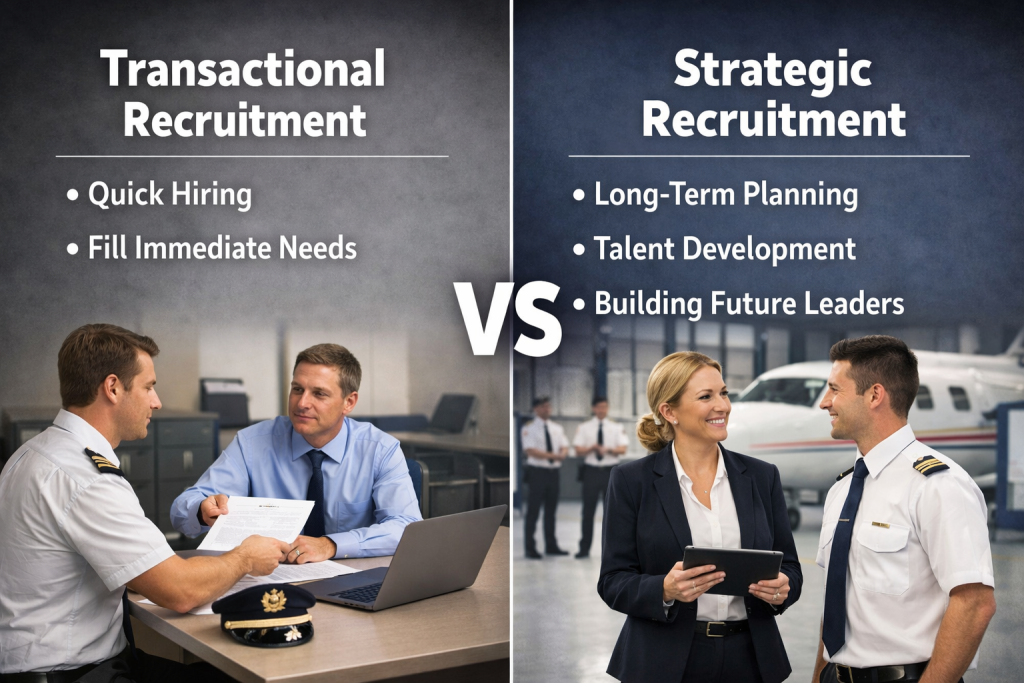
Transactional vs. Strategic Aviation Recruitment: The Core Difference: Speed vs. Sustainability
At its simplest, transactional vs. strategic aviation recruitment comes down to the difference between filling a vacancy quickly and building a long‑term talent ecosystem. Both approaches have their place, but only one positions an organization for resilience and competitive advantage.
What Is Transactional Aviation Recruitment?
Transactional recruitment focuses on immediate hiring needs. It is vacancy‑driven, reactive, and centered on short‑term outcomes. In aviation, this often looks like:
- Filling pilot, technician, or ground‑handling roles as soon as someone resigns
- Relying on job boards and generic advertising
- Prioritizing speed over alignment or long‑term fit
- Limited workforce planning or forecasting
- Minimal employer branding or candidate engagement
This approach can work when the labor market is stable and talent is abundant. Unfortunately, aviation is experiencing the opposite. Pilot shortages, aging maintenance workforces, and global competition for technical talent make transactional hiring increasingly ineffective.
What Is Strategic Aviation Recruitment?
Strategic recruitment is proactive, data‑driven, and aligned with long‑term business goals. Instead of reacting to vacancies, aviation organizations build a talent pipeline that anticipates future needs. Strategic aviation recruitment includes:
- Workforce planning based on fleet growth, retirements, and regulatory requirements
- Building relationships with candidates long before a role opens
- Strengthening employer branding and industry reputation
- Using analytics to forecast talent gaps
- Investing in training, upskilling, and internal mobility
- Partnering with specialized aviation recruitment firms
This approach transforms hiring from a cost center into a competitive advantage.
Why Transactional Recruitment Falls Short in Aviation
The aviation sector is uniquely complex. Safety regulations, certification requirements, and skill specialization mean that not just any candidate will do. This is where the limitations of transactional hiring become clear.
1. Shallow Talent Pools
Aviation roles require highly specific qualifications. Transactional recruitment often relies on broad advertising, which rarely reaches niche talent pools such as avionics engineers or type‑rated pilots.
2. Higher Turnover
When speed is prioritized over alignment, cultural fit and long‑term potential are overlooked. This leads to higher attrition, which is costly in a regulated industry where training and onboarding are extensive.
3. Increased Operational Risk
Understaffing or mis‑hiring in aviation can lead to delays, compliance issues, and safety concerns. Transactional hiring simply cannot support the operational stability aviation demands.
4. Rising Recruitment Costs
Constantly replacing employees is far more expensive than building a sustainable pipeline. Transactional recruitment often leads to repeated hiring cycles, driving up costs.
The Benefits of Strategic Aviation Recruitment
Organizations that shift from transactional to strategic aviation recruitment see measurable improvements across performance, retention, and brand reputation.
1. Stronger Talent Pipelines
Strategic recruitment builds long‑term relationships with pilots, engineers, dispatchers, and other specialists. This reduces time‑to‑hire and ensures a steady flow of qualified candidates.
2. Better Quality of Hire
By aligning hiring with organizational goals, companies attract candidates who fit both the technical and cultural requirements of the role.
3. Improved Retention
Strategic recruitment emphasizes career pathways, training, and engagement—key drivers of retention in aviation.
4. Enhanced Employer Brand
Aviation professionals gravitate toward companies that invest in people, communicate transparently, and offer long‑term growth.
5. Future‑Ready Workforce Planning
Strategic recruitment uses data to anticipate shortages, enabling organizations to prepare years in advance.
Transactional vs. Strategic Aviation Recruitment: A Side‑by‑Side Comparison
Speed vs. Sustainability
Transactional hiring fills roles quickly but often temporarily. Strategic hiring builds a workforce that supports long‑term growth.
Cost vs. Value
Transactional recruitment may seem cheaper upfront, but strategic recruitment delivers greater ROI through reduced turnover and improved performance.
Reaction vs. Proaction
Transactional hiring reacts to vacancies. Strategic hiring anticipates them.
Generic vs. Specialized
Transactional recruitment uses broad methods. Strategic recruitment uses targeted aviation‑specific strategies.
How Aviation Companies Can Shift Toward Strategic Recruitment
Transitioning from transactional to strategic aviation recruitment doesn’t happen overnight, but the payoff is significant. Here are the steps aviation organizations can take.
1. Invest in Workforce Planning
Use data to forecast retirements, fleet expansion, and regulatory changes. This allows recruitment teams to prepare talent pipelines early.
2. Strengthen Employer Branding
Aviation professionals want to work for organizations that value safety, innovation, and career development. Communicate these strengths consistently.
3. Build Long‑Term Talent Communities
Engage with candidates through newsletters, events, training partnerships, and social platforms—even when no roles are open.
4. Partner With Aviation‑Specialized Recruiters
Generalist agencies rarely understand the nuances of aviation hiring. Specialized partners bring industry knowledge, networks, and compliance expertise.
5. Prioritize Candidate Experience
A smooth, respectful hiring process improves acceptance rates and strengthens your reputation in a tight‑knit industry.
6. Develop Internal Mobility Programs
Upskilling and cross‑training reduce external hiring pressure and improve retention.
The Future of Aviation Hiring Is Strategic
As the industry continues to face global talent shortages, the debate of transactional vs. strategic aviation recruitment becomes more than a hiring preference—it becomes a business imperative. Aviation organizations that embrace strategic recruitment will be better positioned to attract top talent, reduce turnover, and maintain operational excellence.
Those that remain stuck in transactional hiring will struggle to compete in an increasingly complex and competitive landscape.
Strategic recruitment isn’t just the future of aviation hiring—it’s the key to long‑term organizational resilience.
<p>The post Transactional vs. Strategic Aviation Recruitment: What Savvy Aviation Leaders Need to Know in 2026 first appeared on Aviation Careers.</p>
]]>